St. John the Baptist’s Cathedral
Improving the visitor experience at St. John the Baptists Cathedral in Norwich,focusing on drawing in new visitors to share their message of “All are Welcome”

The Ask
Focusing on a primarily devoted religious audience, St John Baptist Cathedral came to the NUA with a project brief to expand its visitor audience to the younger generation. With an increasing number of users accessing the internet through various devices such as smartphones, tablets, and desktops, the client wanted to introduce some new technology into the visitor experience, suggesting us to experiment with the inclusion of AR technology, and how it could be used to improve the experience for visitors to the cathedral.
The Brand
Being a religious building, much of the brand of the cathedral is set in stone and cannot be experimented around with. It was highly important within this project that any information included on the design was reviewed and approved by the client before it was shown in user tests.
The Approach
Competitor Analysis
Being based in Norwich, we had the opportunity of comparing the St. Paul Cathedral experience to that of the Norwich Cathedral. This allowed us to learn how AR technology was utilised within the visitor experience, taking inspiration from its online digital 3D map for ideas.
Research Surveys
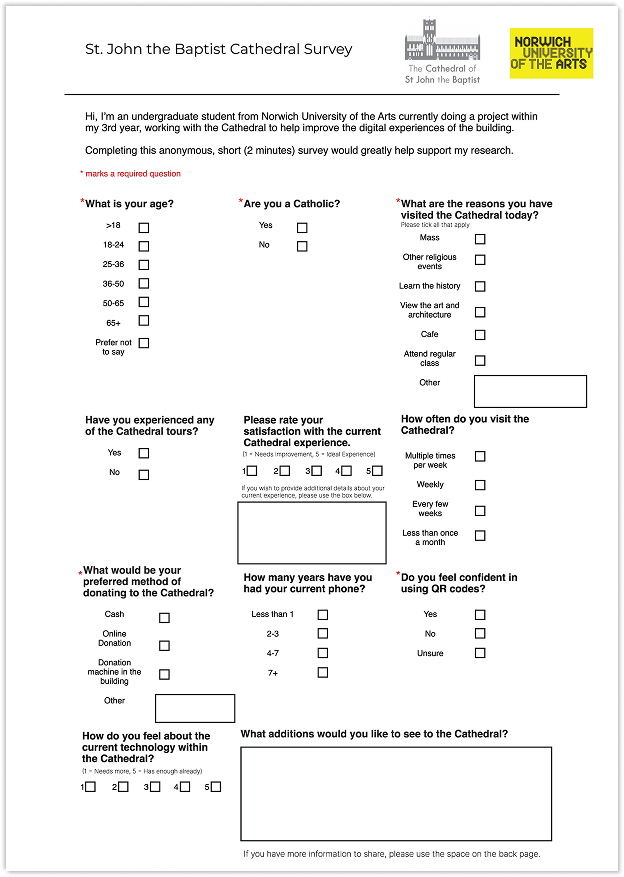
To ensure the final design was accessible to Cathedral visitors, understanding the target audience was a key priority. This was achieved through the use of visitor surveys. Research into survey design informed the decision to present the surveys in a paper format, as the number of questions was low and accessibility was a central concern particularly for older visitors.
As several questions were related to technology, care was taken to ensure they could be easily understood by participants with varying levels of technical knowledge, helping to minimise potential bias in the results.
The AR Problem
How I Adapted
To further develop and refine the designs, regular group critique sessions were held within the UX studio and with fellow students. In addition to this, a functional prototype of a core user flow was created and tested with Cathedral visitors in the Narthex Café.
User testing results were highly positive, with participants expressing excitement about the concept and demonstrating a clear understanding of the system. However, testing also revealed areas for improvement, including difficulties with text readability for some users and minor confusion around the “Themes” tab. These findings informed subsequent iterations, leading to larger text sizes, clearer content structuring, and the renaming of “Themes” to the more familiar and accessible term “Categories”.


Closing Thoughts
Once the final stages of the project concluded and a presentation was given to the client from the Cathedral, it was handed over to other professional UX staff within the university for the project to be taken further utilising the designs and research conducted by myself and other students on the project.
In Conclusion, this project provided me with the excellent opportunity to work individually with a local client, helping to develop important communication skills for presenting a product and idea.
The access to contact the client for relevant information throughout development of the project, including the opportunity for a presentation allowed me to further refine the relevant skills and provided a vital experience for my UX career.